

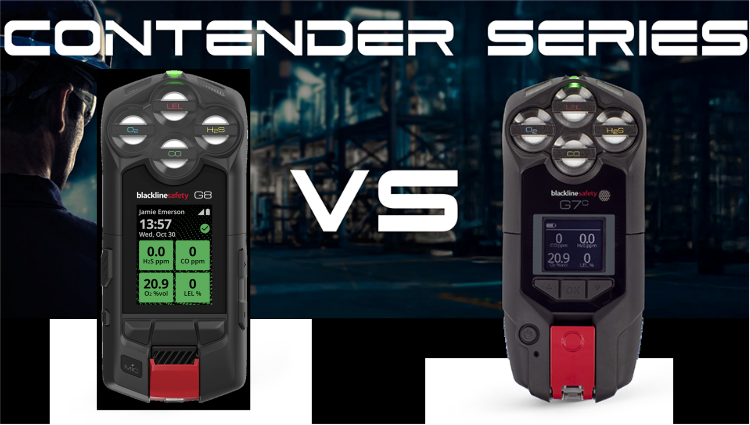
Blackline Safety G8 vs Blackline Safety G7c: A Comprehensive Comparison
Choosing the right connected gas monitor is critical for worker safety, operational efficiency, and compliance. Blackline Safety has built a strong reputation in lone worker protection and cloud-connected gas detection, with the Blackline Safety G7C Multi Gas Detector Diffusion becoming a popular industry standard.
Now, the newer Blackline Safety G8 Portable Single or Multi Gas Detector enters the market as Blackline’s next-generation connected safety wearable. But which one is right for your organization?
This article compares the Blackline Safety G7C and G8 across design, connectivity, gas detection, communication features, durability, and overall value.
Quick Overview
Blackline Safety G7C
The G7C is a cloud-connected personal gas monitor and lone worker device designed for industrial environments. It combines:
- Gas detection
- GPS tracking
- Fall detection
- SOS alerts
- Cellular connectivity
- Optional two-way voice communication
The G7C has become widely used in oil & gas, utilities, wastewater, chemical plants, and confined space operations.
Blackline Safety G8
The G8 is Blackline’s newest connected safety wearable and successor to the G7 line. It expands on the G7C platform with:
- Larger display
- Enhanced communication
- Push-to-talk radio functionality
- Improved GPS accuracy
- Advanced cloud integration
- Faster workflows and device assignment
Blackline positions the G8 as a unified communications and safety platform rather than simply a gas detector.

Design and User Experience
G7C: Functional and Proven
The G7C focuses on reliability and simplicity. Workers can wear it easily on belts, harnesses, or clothing, and its modular cartridge system allows organizations to switch between:
- Single-gas
- Multi-gas diffusion
- Pumped configurations
This flexibility helps reduce hardware replacement costs.
However, the interface is more utilitarian compared to modern wearable devices.
G8: Modernized for Faster Field Operations
The G8 introduces several ergonomic improvements:
- Nearly double-sized display
- Full-color screen
- Better sunlight readability
- Louder speaker system
- Dedicated push-to-talk controls
Users working in noisy industrial environments benefit significantly from the upgraded audio and visibility.
For crews wearing gloves or operating in low-light conditions, the G8’s larger interface can improve usability and reduce response times.
Gas Detection Capabilities
Both devices support:
- Up to five simultaneous gas readings
- Swappable cartridges
- Diffusion and pumped configurations
- More than 20 sensor options
Supported gases include:
- H2S
- CO
- O2
- LEL
- NH3
- CO2
- VOCs and others
The modular sensor system is one of Blackline’s strongest advantages because organizations can adapt monitors to changing worksites without replacing the entire device.
Where the G8 Improves
The G8 adds support for newer sensor technologies and improved processing capabilities. It also enhances live cloud telemetry and real-time situational awareness.
For organizations adopting digital safety ecosystems, the G8 is clearly designed with future scalability in mind.
Connectivity and Real-Time Monitoring
G7C Connectivity
The G7C uses integrated cellular connectivity to automatically connect workers to Blackline Live, Blackline’s cloud monitoring platform.
Features include:
- Real-time gas alerts
- GPS location tracking
- Automated compliance reporting
- Live monitoring support
- Emergency escalation workflows
The device can also support two-way voice communication without requiring a separate mobile phone.
G8 Connectivity
The G8 pushes connectivity further with:
- Automatic LTE carrier switching
- Enhanced GPS/GNSS positioning
- Radio-style push-to-talk communication
- Faster cloud data streaming
- Expanded integration capabilities
Blackline specifically designed the G8 as a “connected platform” capable of integrating with broader digital worksite systems.
This makes the G8 particularly attractive for large enterprises pursuing Industry 4.0 initiatives.
Lone Worker Safety Features
Both devices include:
- Fall detection
- No-motion alerts
- SOS activation
- Check-in timers
- Live emergency monitoring
The G7C became especially notable after achieving BS 8484:2022 certification for lone worker safety compliance in the UK.
G8 Safety Enhancements
The G8 expands safety monitoring with:
- Improved location accuracy
- Faster emergency communications
- Better audio clarity
- Enhanced worker-to-worker communication
In complex industrial sites or remote operations, communication speed can be just as important as gas detection itself.
Durability and Industrial Readiness
G7C
The G7C has a long track record in demanding industries including:
- Oil & gas
- Utilities
- Wastewater
- Petrochemical
- Fire & hazmat
Its rugged construction and modular design have made it a dependable fleet solution for years.
G8
The G8 adds:
- IP67 protection
- Improved hardware architecture
- Enhanced audio systems
- Modernized rugged design
It was specifically engineered for “data-driven worksites” and high-connectivity industrial environments.
Which Device Should You Choose?
Choose the G7C If You:
- Need a proven and reliable solution
- Already operate a G7 fleet
- Want lower upfront costs
- Primarily need gas detection and lone worker safety
- Prefer mature, field-tested hardware
The Blackline Safety G7C Multi Gas Detector Diffusion remains an excellent choice for organizations seeking dependable connected safety without the added cost of advanced communication features.
Related Product Options
Hire Options:
- Blackline Safety G8 Gas Detection Unit From £40.00 Per Week Excl Cart – Tecto Group® Ltd
- Blackline Safety G7c Diffusion From £20 Per Week- Tecto Group® Ltd
- Blackline Safety G7c Pumped From £20 Per Week- Tecto Group® Ltd
- Blackline Safety G7c (Including GPS Capabilities) From £48.15 Per Week- Tecto Group® Ltd
Purchase Options: